Showing posts with label University Atlanta. Show all posts

Saturday, 16 May 2015

Excuses Most People Make That Stop Them from Reaching Their Dreams

Have you ever said or done something that stopped and discouraged you from taking action toward your goals?
Reasons and undesirable self-talk are common problems and are what usually stops most of us from achieving our dreams. But they aren't deceptive until we become aware of them. And it’s not until you become responsive of them that you can start to begin changing them to help you move forward.
Here are 12 of the most common explanations people use that stop them from reaching their dreams:

1.        I’m too old to start.
As long as you’re still living and breathing, you still have all the resources to turn your life around. All it takes is determination and desire.
2.       I’m not talented enough.
Talent alone isn't enough to be truly prosperous. It might help you progress faster, but ultimately, all it requires is hard work and dedication to improve.
3.       I’m not smart enough.
Don’t despair if you feel you lack the knowledge to pursue your goals. There is a good reason why you lack the knowledge—you’re just starting! The key to learning is to start from somewhere and make progress.
4.      I don’t have the support.
While having the support is beneficial, it will not be the reason for your success and is simply ideal for getting you through hard times. The biggest things that matter in your journey toward success and achievement is your drive and motivation.
5.       I don’t have enough time to discover what I like.
If you sit down and make a list of all the things you do in a typical day, you’ll begin to realize that you actually have enough time. Figure out what is wasting your time, and replace it with the things that will get you to your goals.
6.      I don’t know if I will succeed.
The greatest mystery about life is in not knowing what’s going to happen. Sometimes, your journey will take you on roads you never thought existed.

7.       I’m just not lucky enough.
All of us are lucky all of the time. The difference is, you just don’t see the opportunities presented to you due to lack of preparation. Focus on preparing yourself for them, so when an opportunity comes, you naturally will become luckier.
8.      I’m not destined to succeed.
Everything that ultimately happens in your life is all due, in part, to the decisions you make. If that’s your current belief about yourself then, chances are, you’re right.
9.      I’m not motivated enough.
If you lack the drive to do whatever it is you hope to do, there’s a chance you don’t want it badly enough or see it as something you really want.
10.    I’m not educated enough.
Education isn’t necessarily something you have to learn at school. You can never have enough education to get started. If you’re unsure, just take action anyway and learn along the way. Experience always will be the best educator.
11.     I can’t handle failure.
If that’s your belief, then it’s a lie. We are rejected every day of our lives, but we fail to see the rejections because we don’t choose to acknowledge them. Learn to detach yourself from outcomes and to see the process as journey of self-discovery.
12.    I will start tomorrow.
There is no such as a future, only the present. If you genuinely have the time to do something now, then use the opportunity and go and do it. You will feel a lot more energized and motivated, knowing you've pushed yourself and made progress.

Now, stop making excuses that keep you from reaching your dreams. Go forth and prosper!
University of Atlanta makes sure all their students are prominent and respectable addition in the corporate environment and before entering the real world they are very well aware of the importance of communication. These tips will help fresh graduates and people who are already working in the corporate atmosphere. To stay connected and learn more follow us on Facebook , Google plus , Pinterest and Twitter

Monday, 11 May 2015

Research Says Being Disorganized Makes You Smarter

There is a huge pile of paper on your desk, not to mention the paperwork stacked in the drawers, some are also hidden under your desk and you don’t know what to do with them. Well, you are ‘messy’ and you shouldn’t have any shame in calling yourself ‘disorganized’.


For years we kept hearing that being organized keeps you productive but a recent research has revealed that being disorganized too can go to your benefit as the research says that being disorganized can really be a predictor of your smartness. The research was conducted by a neuroscientist named Robert Thatcher who conducted a series of experiments that concluded that the more disorganized you are, the smarter your brain is.

Thatcher says that creativity is a result of several ideas combining or crashing together to produce breakthrough thoughts and novel associations. The more thoughts your mind has the more capacity it has to produce novel ideas by finding associations just like when you are reading more than one book at a time your brain dives into a pool of new ideas and keeps on developing new connections so when your mind wanders its indeed a good thing. According to Thatcher, this process occurs more in a disorganized brain so when your brain remains in a messy and disorganized state you are likely to be more creative and smart.

Many new successful and creative projects are just the result of the creator’s mind wandering at an unexpected time in an unexpected direction and then the idea just hits them. Though you still need to be organized but being rigidly system-oriented makes you perform in an expected way and your brain is likely to become dull and process oriented.

We at the University of Atlanta want you to inject a little bit of disorder and mismanagement in your daily life, let your mind wander a little, go out for an unexpected walk, develop multiple hobbies, borrow ideas, let other use your thoughts and ideas for once to get unplanned success. Join the University of Atlanta network on FacebookTwitterGoogle Plus and Pinterest to keep getting useful updates and stay connected.


Thursday, 30 April 2015

Read this before you make a Donation to the Victims of Nepal Earthquake – University of Atlanta Explore, Educate & Evolve Campaign

This is the right time if you have been thinking of making a donation to help the victims of the Nepal Earthquake. The University of Atlanta Explore, Educate & Evolve Campaign has put together the following important things that you need to do before making a donation to the Nepal Earthquake victims.

The spokesperson from the Center of Global Development has said that the victims of the Nepal Earthquake need your help right now as the first few weeks are the best time to make a donation. The aid that reaches the victims in the first few weeks is life-saving in nature since the local aid capacity at this time is near to zero.


It is a common practice that after every disaster there are a sheer number of organizations that come around asking for charity, but you need to select the right organization so that your donation reaches the victims. Here is what you need to do!

First of all you need to look at the organizations web presence. Check if it has a designated web page for Nepal Earthquake, check if there is some information available online about their previous relief campaigns and if the organization is allowed to spend money for the Nepal victims.

You also need to ensure that the organization you are making a donation to has a presence in Nepal and it is preferable that the organization has a ground presence along with good relations with the government and community as well as it should have some prior experience of disaster relief management.


If you are still confused you can pick out any organization from this list originally published by the New York Times about the groups that are seeking donations for relief efforts in Nepal:
  • American Jewish World Service
  • AmeriCares
  • The Salvation Army
  • International Medical Corps
  • Handicap International
  • Unicef
  • PayPal
  • Mercy Corps
  • Catholic Relief Services
  • Habitat for Humanity International
  • Global Giving
  • The American Jewish Joint Distribution Committee
  • Oxfam
  • World Vision
  • Red Cross
  • United Nations World Food Program
  • Samaritan’s Purse
  • CARE
  • Save the Children
  • Lutheran World Relief
  • The Jewish Federations of North America
  • SOS: Children’s Villages International
  • MAP International
  • International Relief Teams
  • Project Concern International
  • Operation Blessing International

Moreover, It is advised that you avoid making any direct payments to personal bank account numbers and always ask questions if there is not enough information available on the organization’s website because it is your right to know where your money is going, how it is going to be spent and whether it is reaching the victims or not.

Lastly, we will advise you to be patient as the situation in Nepal is quite chaotic. On media it may feel like nothing is being done but it doesn’t mean that donations are not reaching the victims because the destruction is massive and it will take years not months to have things come close to normal.


The University of Atlanta wants you to keep these things in mind before making a donation to help the victims of the Nepal Earthquake. You can follow us on FacebookGoogle Plus , Pinterest and Twitter to stay updated.

Tuesday, 28 April 2015

Saving the Earth with Solar Energy - University of Atlanta Explore, Educate & Evolve Campaign

Our Planet has been suffering from our own neglect and with every passing day the condition is becoming severe. Today the sea levels are quickly rising, we are experiencing intense storms, frequent droughts as well as several other unpredictable climatic changes. These climatic changes have exposed our economy, health, safety as well as the safety of our future generations to a great risk.


Since the first Earth Day in 1970 consistent efforts have been made resulting in several important environmental laws to be ruled out to protect our environment. Today, we have found better and more efficient sources of energy which have proved more environment-friendly and their use is now instrumental in protecting our Planet’s environment.

Solar energy is obtained from the radiation from the sun. It is used to generate electricity with the help of solar panels and it can be used to save our planet from increasing environmental pollution and disasters. Moreover, it is a clean and reliable source of energy which should be used to replace other energy sources that produce high carbon emissions.


Today in America, a solar panel is installed every 2.5 minute of every passing hour according to the Solar Energy Industries Association (SEIA) and with each installation clean energy is provided to us which is direly needed by our Planet’s environment. There was no solar energy panel on the first Earth Day but 45 years later the solar energy produced only in America can be used to power 4 million homes and this number is expected to double by the end of 2016. This increased solar energy produced by the end of 2016 would be equivalent to removing approximately 10 million carbon emitting vehicles from the U.S. roads or shutting down 10 coal powered energy plants that are a major source of carbon dioxide emissions in the U.S.


The solar powered energy has huge potential and we at the University of Atlanta believe that solar energy will be instrumental in providing clean and emission-free energy in the future. Start contributing in saving the Earth by following the University of Atlanta Explore, Educate & Evolve Campaign on FacebookGoogle plus , Pinterest and Twitter.

Thursday, 23 April 2015

What Research Says About the Real Worth of a College Degree? - University of Atlanta Explore, Educate & Evolve Campaign

A college degree comes with much financial burden in the United States. Whether it is at a community college, at a public or a private institution, the cost of getting a college degree was never this much. More importantly when we examine higher education from an investment point of view the picture is not so good. The increasing financial burden along with a gloomy picture of return on investment has raised many reservations about the real worth of a college degree.


Recently a study was conducted in the United States that measured how much the U.S. college fees have increased since the recession. According to the research, the college fees have increased more than 1,225% in the last 36 years, this is more than the average increase in the biggest U.S. expenses that is medical which increased 634% and it has increased even more than the inflation measure consumer price index which increased 279% in the last 36 years. Moreover, the U.S. per student college cost has increased nearly five times the rate of inflation since 1983.

The United States Department of Education has named financial consideration as one of the big reasons for students failing to get a college degree and these students are about 33 percent of the U.S. middle-class students. Even Americans who borrow money for education in form of student debts are at a disadvantage as nearly $1 trillion student loans have been taken by the U.S students making student debt bigger than the credit card debt in America.

A more recent 2014 research from the Pew Research Center showed that not going to college is even worse and it proves to be much more costly in the later years. The research showed that students who successfully graduate from college earn US$17,500 more than their peers who are only high school graduates and when we start to compare graduates and non-graduate salaries the decision whether to get a college degree or not gets all clear.


The University of Atlanta strongly believes that it is extremely important to invest in a college degree today and the reason is quite obvious because who fail to do so are falling further and further behind. The University of Atlanta Explore, Educate & Evolve Campaign brings you most useful facts and information that prepare you for academic and professional success, you too can join the campaign by following us on Facebook , Google plus , Pinterest and Twitter

Reduce, Reuse & Recycle with University of Atlanta Explore, Educate and Evolve Campaign

Our land is our treasure and to save it from hazards is our social responsibility. We want you to make smart choices and save the mother earth. The message of Reduce, Reuse & Recycle, is to eliminate problems such as global warming and deforestation. With University of Atlanta Explore, Educate and Evolve Campaign, follow these 3R’s and help create a better world.  

Let’s learn how to make these three R’s work:
REDUCE
The best way to manage waste is to not produce it. This can be done by shopping carefully and being aware of a few guidelines:
Tips that can help you contribute.
-          Buy products in bulk, avoid over-packaged goods, especially ones packed with several materials such as foil, paper, and plastic.
-          Make sure that you always purchase durable goods - ones that are well-built or that which carry warranties.
REUSE
It makes economic and environmental sense to reuse products. Sometimes it takes creativity.
-          One can save paper and plastic bags, repair broken appliances, toys and furniture.
-          Use reseal-able containers rather than plastic wraps.  Use ceramic coffee mug instead of paper cups.
RECYCLE
The process of recycling means to make a new product out of an old product.
 You can contribute by:
-          Purchase goods made from recycled material. Look for the recycling symbol or ask store managers or salesmen.
-          Check collection centers and curbside pickup services to see what they accept, and begin collecting those materials.


Learn to become environmental friendly and use tips that would save the earth. University of Atlanta Evolve, Educate and Explore campaign wants to spread the message of education and humanity this campaign is an initiative towards a better and brighter tomorrow.  
Stay connected with University of Atlanta and explore ways to make a difference join us and share your contributions. To get frequent updates don’t forget to follow UofA on Facebook , Google plus , Pinterest and Twitter.


Thursday, 16 April 2015

These Students Learned the Most Powerful Lesson of Their Lives in 5 Minutes – University of Atlanta Explore, Educate & Evolve Campaign


You need to experience life in order to learn valuable lessons. But this is not the case every time as you need to be curious to learn from others too. You can easily learn valuable lessons from other people and apply them in your life. Here is a powerful lesson a high school teacher taught his students about life, privilege and the need for education.

Let’s Play a Game

The teacher told the students they will be playing a game and asked them to take a piece of scrap paper and start to crumple it.


Once the students were done crumpling the paper the teacher moved the recycling bin to the front of the class.


The teacher then said “the Game is pretty simple as all of you represent the population of our country and each one of you has an equal chance to move into the upper class and become rich.


What You Need To Do

All you have to do is throw your crumpled paper into the recycle bin without leaving your seat.


Immediately the students who were sitting at the back of the classroom responded that this is not fair as the students who are sitting in front have a better chance of throwing the crumpled paper in the bin.


But every student had to take the shot from the same position so they did.


Results

Very few of the students from the back managed to get their crumpled papers into the bin whereas almost everyone from the front row successfully made it.


Life is Unfair

The teacher then concluded that you have a better chance if you are closer to the recycle bin. But if you are not closer to the bin it is not your fault this is how life is. ‘It is unfair’.


Some Are Born Privileged

Did you notice that only the students in the back of the row complained? While the ones in the front did not, this is called privilege and this is how it works. Some people are just born into it and they are never aware of what privilege they have over others, the only thing they see is that they are close to their goals.

What is Your Privilege?

The University of Atlanta Explore, Educate & Evolve Campaign wants you to be aware of your privilege which is your ‘education’. At the University of Atlanta, we believe that you can use your privilege that is your education to get ahead of those who were born with privilege and this is how you make your life fair. Become a part of our campaign follow us on FacebookGoogle plusPinterest and Twitter.

Monday, 13 April 2015

These 10-Year-Old Website Screenshots Show How Fast the Internet Has Changed - University of Atlanta Explore, Educate & Evolve Campaign


Today, there are more than three billion internet users in the world which accounts for 40 percent of the world’s population. Looking back at these website screenshots you will realize how far we have come from the digital Stone Age which was only 10 years ago.

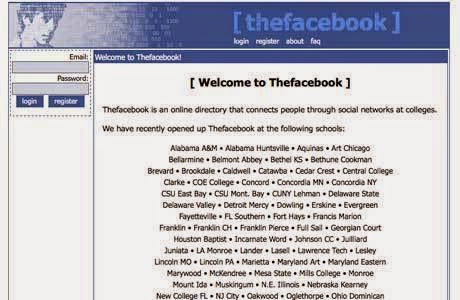
Facebook.com

The world’s largest social networking site ‘Facebook.com’ which was founded in 2005 currently has over 1.3 billion active users and 890 million daily active users. Initially, it was just a social network site for Harvard students but soon it took over the world. Here is how it looked like back in 2005.

Source: web.archive.org


Y
Youtube.com

The world’s largest video sharing platform was launched in 2005 and it had only 65,000 daily video uploads and around 100 million video views every day, which in 10 years grew to 4 billion daily video views and 300 video hours uploaded every minute. This is how the site looked in 2005.

Source: web.archive.org


T
Twitter.com

Twitter that introduced the world with short 140 character crisp messages in 2006 was initially a service that people used to answer only one question that was ‘what are you doing’. Initially, twitter users were posting 20,000 tweets a day which in nine years grew to 500 million tweets a day and 288 million active users. This is how the site looked like in 2006.

Source: web.archive.org


G
Google.com

Google.com is the heart of web search. The initial site would search nearly 25 million web pages, had a subscription option and updated monthly. This is how the internet giants looked like in their first days.

Source: web.archive.org


In 2005, Google was quite close to what it looks today but still only searched 8 billion pages and also had online shopping search engine named as ‘Froogle’. 

Source: web.archive.org


Today, Google search searches more than 1 trillion unique web pages and is updated several times a day.


Wikipedia.org

The free encyclopedia that anyone is able to edit started with as less as 6,000 pages and wanted to make over 100,000 pages. Today, Wikipedia has over 35 million pages and 70,000 active editors in its community. This is how they used were like in their early days.

Source: web.archive.org


U
University of Atlanta Explore, Educate & Evolve Campaign believes we have come far in this digital age but we still have a long way to go as who is to say that in the coming future there wouldn’t be people who would write about how outdated people were in 2015. Become a part of the Explore, Educate & Evolve Campaign by following us on Facebook , Google plus , Pinterest and Twitter and stay ahead.


Just a Little Something about the High Museum of Art in Atlanta – University of Atlanta Explore, Educate and Evolve Campaign

Atlanta is known for is unique history, It is a powerhouse of higher education and the city which rose from the ashes. There's so much more that we still need to explore about the city of Atlanta.          
University of Atlanta Explore, Educate and Evolve Campaign envisions to discover and spread it among those who wish to learn.

We know that Atlanta is known for its beautiful architecture which makes every building a tourist attraction. The High Museum of Art in Midtown frames a fundamental node of cultural activity for the Arts District of Atlanta.


Architecture of High Museum of Art

The museum, which opened in the early 1980s, was designed by Richard Meier, who won the 1984 Laureate of the Pritzker Architecture Prize. The site plan and building alignment welcome the public and pull guests deeper into the site, which is stretched on a gentle hill where they can be surrounded by art. 

Unique work of art

The sculptural design of the museum’s exterior forms a distinctive work of art that appropriately houses other works of art. The famous architect used his signature elements of white metal panels, glass and concrete to carve an architectural form that integrates multiple symmetrical combinations, creating a lively design that becomes a tribute to the art it houses.

Exterior of the building

The four-sided towers that house the art and vertical circulation are arranged on the facade to help define a hierarchy of spaces and break down what would otherwise have become an impressive mass on the site. These rectangular forms are hauled away from the access to expose the tube-shaped heart of the museum, which is fully glazed to provide public views into the core of the structure.

Interior of the building
The unique design of the interior is like an engaged tour of how the museum should be experienced. The architect introduces free-form curves to house free flowing areas of interior circulation, and he uses a strong diagonal entry ramp to frame the guest's vision firmly toward the center of the museum’s interior atrium.
The grand atrium the most amazing element of this building’s design. The atrium, which is decorated by its incorporation of natural lighting, the volume of space, and connectivity, creates a design where guests come to bond, study, rejoice and dream. You feel like the building is covering its arms around you and alluring you to come in, stay a while, see more, dream more, and come back again.

University of Atlanta Explore, Educate and Evolve Campaign is all about sharing the most useful pieces of information among all. If you want to be a part of this campaign follow us on Facebook , Google plus , Pinterest and Twitter.